
Context
Cambodia is one of the most disaster-prone countries in the world and is highly impacted by climate change-induced flooding and droughts. Weak adaptive capacity, poor infrastructure and limited services exacerbate the country's vulnerability to climate variability.
Monsoon rains are common from May to October bringing over ¾ of the country's annual rainfall which results in the Mekong and its tributaries, as well as Tonle Sap Lake recurrently flooding. Approximately 80% of the population live along the Mekong River. Rising sea levels also pose a threat to coastal areas which already suffer from stormsurges, high tides and beach erosion exacerbated by the deforestation of the protective mangrove forests. An ever increasing problem is the occurrence of erratic rainfall, which has contributed to more frequent droughts in Cambodia. Droughts, coupled with poor management of water sources, have severely impacted communities and their food security - for example, drought affected 1 million hectares of rice fields between 2015-2019, completely damaging 201,490 hectares at an estimated value of $100 million (Ministry of Environment). Early warning systems (EWS) have been developed in Cambodia but are not achieving their desired impact. During consultation workshops with commune leaders and the subnational disaster management committees in January 2023, it was identified that existing EWS needed to be upgraded to ensure that messaging is as widespread as possible and accessible to all, even those who cannot read. Additionally, commune leaders noted the importance of being able to measure the number of people registered in each location to be able to monitor the community awareness and response. Current rapid assessments of disasters at the sub-national level are not effective, as the existing PRISM system is not well understood, and the data collection takes time. (PRISM is a government data collection tool used to timely and effectively respond to disasters, but which still has many limitations such as lacking knowledge from sub-national levels ). As PRISM is a database that records and reports on disasters that
have occurred, EWS 1294 will complement PRISM by providing information to communities and NDCM prior to the disaster in order to trigger the EWS alert. The data registered by the GWLMs and water sensors will supplement the data collected by PRISM.
Project Objectives
The project seeks to ensure Early Warning Systems are strengthened to protect affected communities in Cambodia from the ever-worsening effects of climate change (specifically flooding and drought). It seeks to address the
aforementioned challenges by:
- adapting and improving the 1294 EWS software and SMS service by expanding its coverage to more provinces affected by climate change and also focusing on the drought risk, because as of now 1294 focuses mostly on flood early warning through its Ground Water Level Monitoring Systems (GWLM). However, the damage caused on food security and livelihoods by droughts in Cambodia is only second to flooding.
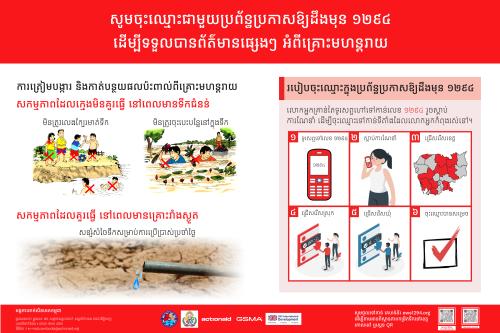
- increasing the number of users of the 1294, by raising public awareness of the SMS service, including its function that uses voice messages instead of text for people who cannot read, to ensure messaging is as widespread as possible and accessible to all.
- Increasing capacity and coordination amongst relevant government ministries to enhance effectiveness of intervention related to disaster response and preparedness, especially promoting EWSs such as 1294. ActionAid will work alongside the
Ministry of Rural Development (MRD), National Committee for Disaster Management (NCDM) and the Ministry of Water Resources and Meteorology (MOWRAM) to provide support in coordination and technical capacity strengthening. - Equipping the 1294 service with a function to report loss and damage, as this can support sub-national disaster management teams in their rapid assessment of disasters and therefore in their response efforts.
Key Activities
- In coordination with the National Committee for Disaster Management (NCDM), the Ministry of Rural Development (MRD) and the Ministry of Water Resources and Meteorology (MOWRAM), EWS and field stations were monitored, maintained, upgraded and expanded in existing and new disaster-prone provinces and the drought component was added. These triggerred EWS messages to the community for flooding and drought trigger points.
- Training of government officials from local to national level as local partners on EWS, DRR, climate change and GWLM operations.
- Communities were trained with awareness raising messaging on the EWS 1294 availability and its supportive functions through the establishment of an EWS online platform, IEC materials and community awareness raising sessions and campaigns, targeting vulnerable communities.
- Through local, regional, national and international sector meetings on DRR and climate change, local CSOs will be engaged to strengthen the coordination of the project. This engagement will enhance the management of EWS1294 and the sustainability and longevity of the EWSʼ prevalence and impact
Target Groups
- 371 Government and NGOs
- 145K Service Users
- 581K Indirect Benefit
Timeframe
1 Nov 2023 to 31 Mar 2025
Total Budget
£376,176